Your browser is not supported.
For the best experience, please access this site using the latest version of the following browsers:



By closing this window you acknowledge that your experience on this website may be degraded.
Honeywell Aerospace unveils satellite antenna enabling safe, reliable drone operations beyond visual line of sight
Breakthrough multilink connectivity proven in live demonstrations, paving the way for safe integration of unmanned aircraft into shared airspace
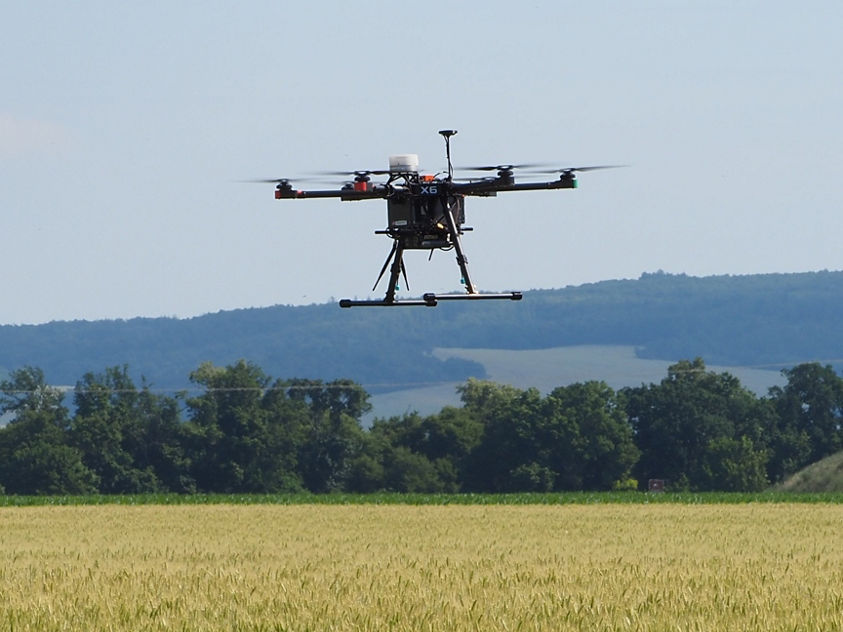
BRNO, August 18, 2026 – Honeywell Aerospace (NASDAQ: HONA) today announced the successful validation of a new satellite communications antenna designed to enable safe, reliable command-and-control of unmanned aircraft flying beyond visual line of sight (BVLOS). Developed at Honeywell Aerospace’s European R&D center in Brno, Czechia as part of the European Space Agency’s (ESA) Iris Global program, this breakthrough marks a major advancement towards scaling routine commercial drone operations.
The lightweight antenna provides continuous, resilient connectivity essential for real-time flight control, airspace awareness, and conflict avoidance. These core capabilities are required for BVLOS services such as infrastructure inspection, logistics, and emergency response. The technology was validated in partnership with Viasat using its highly reliable satellite network under real flight conditions.
“As regulators and operators prepare for scaled BVLOS operations, resilient command-and-control connectivity is foundational,” said Martin Mlaskač, Senior Technical Manager at Honeywell Aerospace. “Flight testing at Budkovice Airport confirmed that combining satellite and terrestrial communication links ensures operators maintain positive control of the aircraft even in demanding or complex scenarios.”
During the demonstrations, operators were able to adjust flight trajectories and maintain safe separation from other airspace users when potential conflicts were detected, including scenarios where another drone crossed a planned flight path. Honeywell Aerospace’s antenna was integrated with its VersaWave satcom system, enabling seamless switching between satellite and terrestrial networks to maintain uninterrupted command-and-control.
Demonstrating safe integration into shared airspace
The flights formed part of a broader test campaign showcasing how resilient connectivity supports safe drone integration into airspace shared with crewed aircraft. Several missions were conducted within a U-space environment—Europe’s digital, automated, and regulated airspace framework for unmanned aircraft.
Frequentis provided its Uncrewed Traffic Management (UTM) suite, enabling secure data exchange for operator registration, flight authorizations, and geo-awareness. A Honeywell Aerospace Ground Control Station (GCS) equipped with a ground-based Detect-and-Avoid (DAA) system processed telemetry from both the drone and an actual crewed aircraft acting as an intruder. This consolidated airspace picture allowed the GCS to identify potential conflicts, alert the operator, and recommend safe route adjustments.
“The successful demonstration underlines the importance of strong industry collaboration,” said Bernhard Kirschner, Solution Architect for Integrated Lower Airspace at Frequentis. “Together with our partners, we’re building the digital infrastructure required for safe and efficient unmanned aviation.”
Once an updated flight plan was approved by the operator, it was uploaded and executed automatically, illustrating how resilient connectivity and automated U-space services work together to ensure safe BVLOS operations.
"The successful demonstration underlines the importance of strong industry collaboration.Together with our partners, we’re building the digital infrastructure required for safe and efficient unmanned aviation.”
Bernhard Kirschner,
Solution Architect for Integrated Lower Airspace at Frequentis
Once an updated flight plan was approved by the operator, it was uploaded and executed automatically, illustrating how resilient connectivity and automated U-space services work together to ensure safe BVLOS operations.
Preparing the technology for commercial deployment
Czech industrial partners contributed to prototype production, and Brno University of Technology supported radio-frequency validation. Honeywell Aerospace is now preparing the antenna for industrial production and evaluating Czech suppliers for inclusion in its manufacturing supply chain. Viasat provided the satellite network infrastructure supporting the demonstrations.
“UTM integration and resilient network capabilities are core pillars of BVLOS, not just nice add-ons,” said Joel Klooster, SVP Aircraft Operations and Safety at Viasat. “Our ongoing collaboration in the ESA Iris program shows how advanced multilink networks can enable real-time interaction, airspace awareness, and continuity of control in live operating conditions. These are all critical elements for scalable unmanned operations.”
Program partners and support
The initiative is co-funded by the European Space Agency (ESA), with additional support from the Ministry of Transport of the Czech Republic and the Ministry of Industry and Trade of the Czech Republic.
About Honeywell Aerospace
Honeywell Aerospace (Nasdaq: HONA) is an independent global aerospace and defense company whose critical technologies are broadly deployed on the world's leading commercial air transport, business aviation, defense and space platforms. These integrated solutions enable safer, more efficient, and more reliable missions. Headquartered in Phoenix, Arizona, the company employs more than 36,000 people globally and supports more than 10,000 customers. With a broad portfolio spanning avionics and navigation systems, engines and power systems, and control systems for aircraft, Honeywell Aerospace combines deep engineering expertise and an unrelenting commitment to quality to drive innovation and long-term value for the aerospace industry. For more information, visit honeywellaerospace.com or follow Honeywell Aerospace Technologies on LinkedIn.
About Frequentis AG
Frequentis stands for a safer world. Our solutions are used in our customers’ command and control centres to help them make the world safer.
Frequentis is a world leader in high-tech solutions for Air Traffic Management, supporting both civil and military air traffic control organisations, as well as Public Safety and Transport, where police, emergency rescue services, fire brigades, railways, coastguards, and port authorities rely on our extensive portfolio.
The listed family business based in Vienna, Austria, drives innovative and sustainable solutions for safety and security in everyday life and in the safety-critical sector. Its air traffic optimisation solutions for air traffic control centres are contributing to reducing emissions.
As a global player with more than 2,600 employees (full-time equivalents/FTE), Frequentis has a worldwide network of companies in over 50 countries. Its products, services, and solutions are used in around 150 countries. Shares in Frequentis are traded on the Vienna and Frankfurt stock exchanges; ISIN: ATFREQUENT09, WKN: A2PHG5. In 2025, revenues were EUR 580 million and EBIT was EUR 47 million.
Disclaimer:
Views expressed in this press release can in no way be taken to reflect the official opinion of the European Space Agency.