


Anthem™
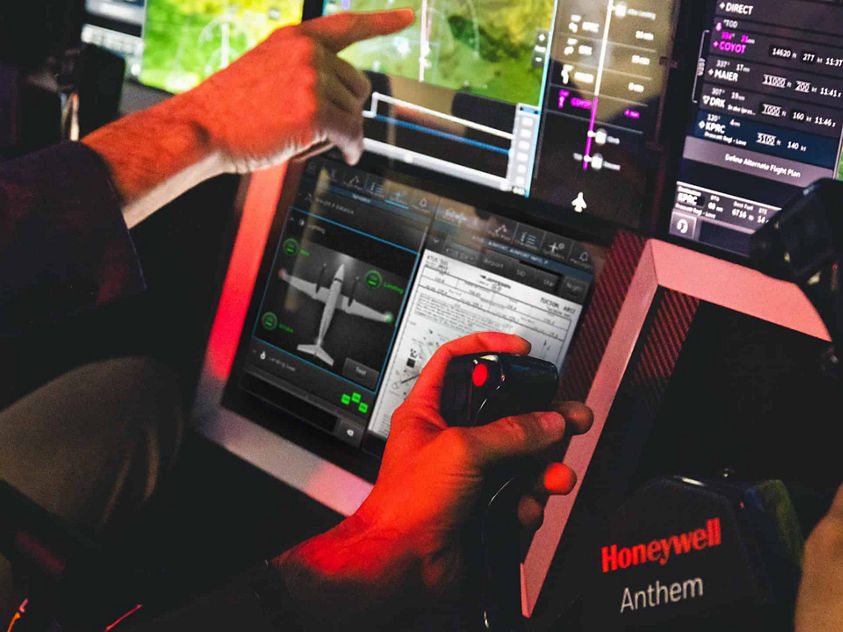
Honeywell Anthem gives you everything - from primary flight display, navigation maps, charts, and radio controls—all shown exactly how you want on any display.

Your browser is not supported.
For the best experience, please access this site using the latest version of the following browsers:
By closing this window you acknowledge that your experience on this website may be degraded.
Anthem, here’s your standing ovation.
The next-generation flight deck from Honeywell Aerospace Technologies has won a Good Design Award, one of the most prestigious and longest-running competitions in the world of design.
The award, given jointly by the Chicago Athenaeum Museum of Architecture and Design and the European Centre for Architecture, Art, Design and Urban Studies, is the second recent honor for Anthem. In December the UX Design Awards, which are given by the International Design Center of Berlin, featured the system in its annual yearbook of the world’s best design.
Anthem and other honorees “won over the jury not only through their aesthetic, but also thanks to their incomparable functionality,” Christian Narkiewicz-Laine, chief curator of the Good Design Awards, said in announcing the winners.
“The winning designers and manufacturers have all taken on one of the biggest challenges in the global design world: to produce a meaningful, superb, and timeless product design that withstands function, lasting use, and inspiring and profound relevance,” he said.
Anthem is the first cloud-connected cockpit system. It aims to be as user-friendly as the best smartphone apps and as pleasing to the eye as the dashboard of a luxury car.
“These recent honors are amazing endorsements of our work,” said Kevin Suits, who oversees the design team at Honeywell Aerospace Technologies. “Honeywell Anthem is turning heads and taking its place among the best-designed products in the world.”
The Good Design Awards were founded in 1950 by legendary designers Charles and Ray Eames, architect Eero Saarinen, and Edgar J. Kaufmann Jr., a curator at the Museum of Modern Art in New York.
This year’s competition attracted more than 4,000 entries. Anthem was honored in the Transportation category.
One of Honeywell Aerospace’s customers, Dassault Aviation, also picked up an award in the same competition. Dassault won for the Falcon 10X business jet, which features Honeywell Aerospace avionics.
The UX Design Awards, meanwhile, included Anthem in its 2022 Yearbook, a roundup of the world’s best design work. The International Design Center of Berlin publishes the book and has bestowed the awards since 2015.
Anthem’s look and feel is familiar to anyone who has used a high-end smartphone or tablet – and that’s no coincidence. In recent years the company has built a world-class, in-house design studio called Honeywell User Experience (HUE), as well as a new Innovation Team that helps identify user needs.
Both groups work hand-in-hand with programmers, pilots and the company’s Human Factors group, which rigorously tests every new feature in the company’s own fleet of aircraft and helicopters.
Many team members are pilots themselves, so they have an in-depth understanding of what users need.
“Working on Honeywell Anthem has been an exciting experience for our team,” Suits said. “We did extensive research and talked to lots of pilots to inform the Anthem design. What we found was that pilots wanted flight decks with a more contemporary look and feel, intuitive user interfaces, and the ability to customize the cockpit layout.”
Anthem is designed to be constantly connected to the cloud, opening up vast new possibilities for simplifying flight. The software platform can be customized for any type of aircraft, from large passenger planes to business jets and emerging classes of urban air mobility vehicles.
The system addresses two major issues in the aviation industry. It increases safety and efficiency through enhanced automation, and it integrates disjointed systems to smoothly deliver crucial information to pilots.
It includes a predictive user interface, mission manager and a “smart pilot” assistant. All this makes flying a breeze, according to experienced pilots who have tried Anthem.
Anthem also prioritizes security with a secure web browser and avionics that are always connected. These features enable data transfer to secure, ground-based servers and reduce pilot preparation time by up to 45 minutes per flight.
The system has already been chosen by Vertical Aerospace, Lilium and Supernal for their urban air mobility aircraft.