


Defense
Learn how Honeywell Aerospace strengthens modern defense through integrated technologies built for complex missions.

Your browser is not supported.
For the best experience, please access this site using the latest version of the following browsers:
By closing this window you acknowledge that your experience on this website may be degraded.
From advanced connectivity to increased automation, we’re leveraging new technologies to ensure ongoing resilience and readiness for the road ahead.
Aging fleets. Increased air traffic and operational complexity. Evolving threats and mission requirements.
Defense modernization has become essential for maintaining mission readiness, operational resilience, and air superiority across increasingly contested environments.
Modernization is critical to ensuring readiness for our increasingly complex, increasingly contested airspace. As new technologies emerge and evolve, the race to out-think and out-perform the threat only accelerates. And only through a process of constant innovation are we able to keep pace.
The latest advances in artificial intelligence, automation and autonomy are rapidly creating new opportunities for sensing, navigation and computing technologies, enabling us to effectively respond to increasing demand for better connected, more datadriven operations. With each step forward, we’re making it possible for the U.S. and its allies to enhance safety, situational awareness and mission effectiveness while improving sustainability and reducing lifecycle costs.
Expanding mission capabilities, enhancing resilience and reducing pilot workload are critical to ensuring readiness for today’s missions — and tomorrow’s. Recent innovations in navigation, communications, flight management and aircraft systems are making it possible.
Unified flight deck environments are now able to rapidly provide pilots with the data they need to make fast, confident decisions.
The Primus Epic 2.0 and Epic 2.0+ integrated avionics systems represent the latest iterations of this technology — and will pave the way for the next generation of advanced flight deck solutions. Due to launch in 2026, Epic 3 will then keep the platform relevant for another 10 to 15 years.
In the meantime, breakthrough avionics like Anthem are reimagining the future of flight itself. Its modular architecture supports more autonomous and semi-autonomous operations while delivering a nearly 50% reduction in size, weight and power requirements.
Together, these technologies illustrate the dual role modernization plays in driving future readiness and mission success: ensuring today’s fleets effectively adapt to changing requirements and introducing next-generation capabilities that will one day support future aircraft. /
Together, these technologies demonstrate the critical role of aircraft modernization in enhancing mission readiness and operational success, helping current fleets adapt to evolving requirements while introducing advanced capabilities that will power the next generation of aircraft.
Together, these efforts enable us to keep pace rapidly evolving threats and mission requirements.
The advanced connectivity capabilities that power flight deck solutions like Epic and Anthem are also evolving basic cabin SATCOM into resilient, multi-network communications architectures.
Technologies like JetWave X are now providing the high data rates and resilient multi-network connectivity defense forces need to future-proof satellite communications. Its open architecture is designed to accommodate additional networks and evolving SATCOM infrastructure.
This makes it a practical solution for both legacy platforms and newer ISR (Intelligence, surveillance and reconnaissance) aircraft, transports and UAVs. It helps ensure warfighters have access to reliable, high-speed satellite communications, enabling faster intelligence sharing, enhanced command-and-control capabilities, and improved mission coordination across distributed and contested operational environments.
Mobile, modular and AI-powered, new Counter-UAS (CUAS) capabilities are enabling military forces to adapt to an airspace increasingly crowded with inexpensive, autonomous and wellcoordinated drones and drone swarms.
In this new threat environment, modernization plays a vital role enabling the U.S. and its allies to maintain air supremacy.
By taking an open, layered approach, these efforts allow seamless incorporation of various sensors and effectors that facilitate integration into broader defense architectures and adapt today’s fleets to entirely new categories of airborne threat.
The more contested our operating environments become, the more critical it is to upgrade our Position Navigation timing (PNT) capabilities.
Solutions like EGI with M-Code are making it possible, evolving legacy SAASM-based GPS/INS into secure, resilient M-Code-enabled PNT that increases our resistance to GPS jamming and spoofing.
Like many other military modernization efforts, the system relies on an open architecture to maximize adaptability. It can be easily integrated into existing installations with minimal aircraft changes while creating a path forward for increasingly GPS-independent navigation.
Resilient navigation capabilities are becoming essential to mission assurance, operational continuity and success in contested environments.
Enhanced situational awareness is critical to the success of any mission. And in today’s hyper-complex battlespace, our ability to equip warfighters with the data they need is more important than ever.
The Honeywell 360 Display — a wearable system that uses augmented and mixed reality to integrate external camera feeds, sensor information and operational data into a single, highresolution, 360° view — takes that ability to the next level.
It transforms how warfighters see and navigate the battlespace and turns mission-critical data into a tactical advantage.
In today’s world, long-term mission success requires continuous adaptation. And as the pace of technological change increases, the more critical it is for us to view modernization not as a one-time equipment upgrade, but as a way to view and approach the process of innovation itself.
Drones and counter-UAS, electronic warfare, AI, autonomy, cyber threats, GPS jamming/spoofing and contested communications will continue to evolve. And only through continuous modernization will we be able to stay a step ahead.
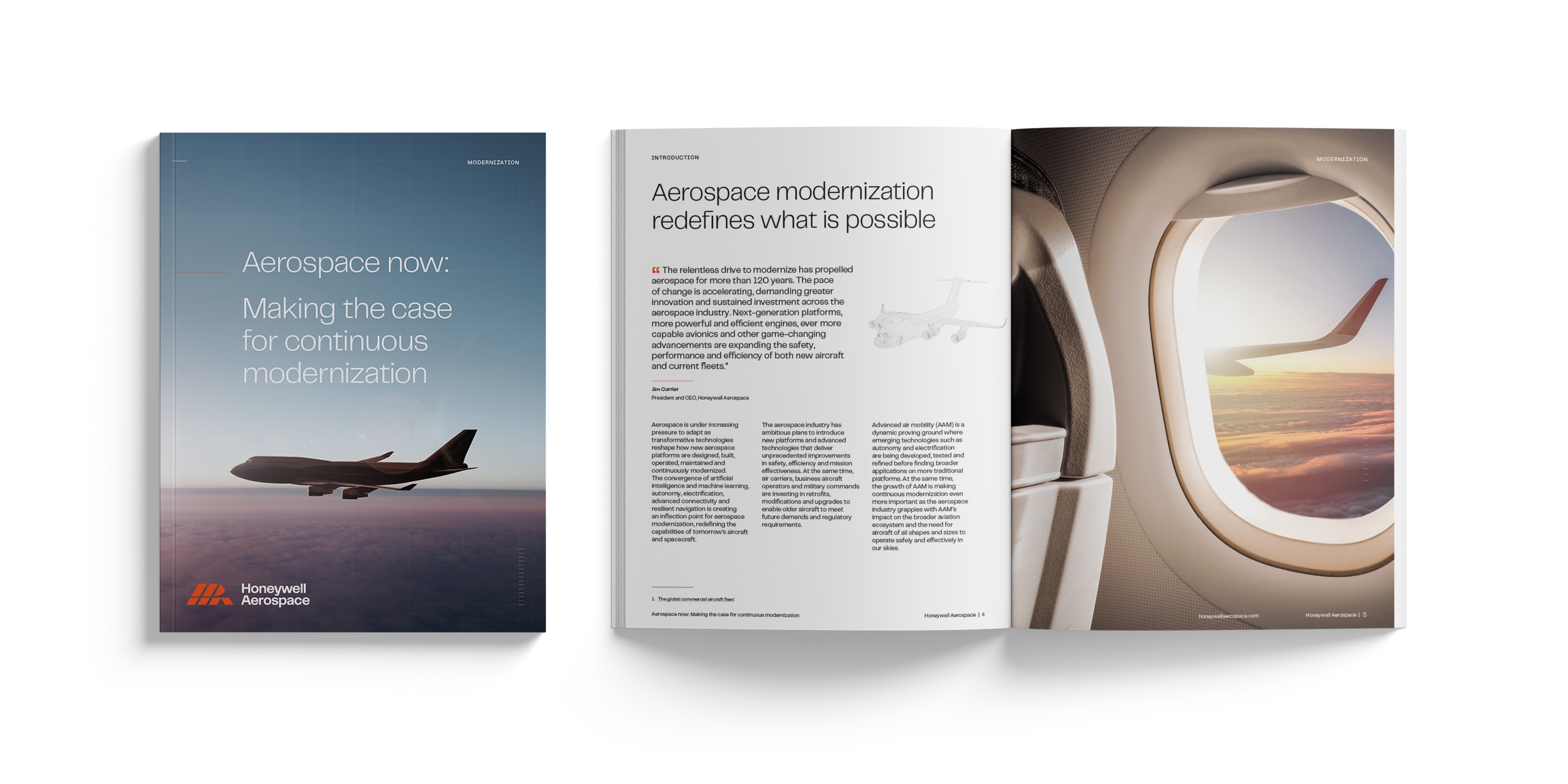
See how the defense industry is extending aircraft life and capabilities to constantly maintain the competitive edge.