Your browser is not supported.
For the best experience, please access this site using the latest version of the following browsers:



By closing this window you acknowledge that your experience on this website may be degraded.
Why aircraft motion controls are becoming more electric
Learn how more-electric motion controls are giving engineers new ways to improve aircraft performance, simplify aircraft systems and support the next generation of flight.
Key takeaways
- Why aircraft motion controls are evolving alongside more-electric aircraft
- How electromechanical actuation can improve aircraft performance, maintainability and design flexibility
- Why different aircraft require different motion control solutions
- How more-electric motion controls are influencing commercial, defense and advanced air mobility aircraft
Why electromechanical actuation is changing motion controls
Flight depends on a series of carefully controlled movements, many of which go unnoticed.
Control surfaces respond to pilot inputs. Landing gear extends and retracts. Brakes stop aircraft weighing thousands of pounds at high speeds. Newer aircraft introduce additional moving systems, from tilt rotors to folding wings, each requiring precise, reliable control.
For decades, hydraulics have been the preferred solution for many of those functions. They remain a proven technology because they deliver the force and reliability aircraft demand.
Commercial aircraft continue adding connected systems while defense platforms require increasing electrical capacity for sensors, mission equipment and electronic warfare. Advanced air mobility (AAM) aircraft are introducing entirely new ways to control flight with multiple independently controlled rotors and flight surfaces.
Those demands are changing how engineers design motion controls and integrate them across the aircraft.
"You have systems that generate power, you have systems that distribute that power, and then systems that consume power,” explains Rich DeGraff, president and chief executive officer of control systems at Honeywell Aerospace.
Motion controls sit at the intersection of all three.
Motion controls are evolving with aircraft design
Electrification changes how engineers approach the systems responsible for moving the aircraft.
Traditional hydraulic systems rely on pumps, reservoirs, plumbing and fluid routed throughout the aircraft. Electromechanical actuation performs that same function using electrically powered actuators that convert electrical energy into controlled mechanical movement.
Without routing hydraulic lines throughout the airframe, engineers can evaluate different approaches to system layout, maintenance and overall aircraft architecture.
AAM has helped accelerate the development of electromechanical motion controls because many eVTOL aircraft depend on multiple independently controlled rotors and flight surfaces operating within demanding size, weight and power constraints.
David Shilliday, vice president and general manager of power systems at Honeywell Aerospace, says those architectures are also giving aircraft designers new options as they develop future aircraft.
Commercial aircraft, defense platforms and AAM vehicles each have different mission requirements, but they're asking many of the same engineering questions:
- Where should electrical power be distributed?
- Which systems benefit most from electromechanical actuation?
- How can motion controls support the aircraft while balancing performance, maintainability and efficiency?
Motion controls are expanding what aircraft can do
Commercial aircraft manufacturers are evaluating ways to improve efficiency, simplify maintenance and reduce weight where it makes sense. Defense platforms continue adding mission equipment that requires more electrical power while operating in demanding environments. AAM developers are designing aircraft that depend on coordinated motion across multiple rotors and control surfaces from the outset.
Those aircraft may look very different, but they share the same challenge of needing motion control systems to better integrate with the aircraft's electrical architecture.
Brian Berry, general manager of actuation systems at Honeywell Aerospace, points to another industry when explaining the broader impact of electromechanical systems.
"The car that you drive today is much safer than it was even 10 years ago,” Berry says. “Because of the addition of things like anti-lock brake systems. Those are electromechanical in nature."
Aircraft operate under far different certification standards than automobiles, but the underlying trend is similar. As electrical systems mature, engineers gain new ways to improve performance while giving aircraft designers additional flexibility.
The future of aircraft motion controls
Motion controls will continue evolving as aircraft manufacturers balance different mission and fleet requirements.
Across commercial aviation, defense and AAM, Honeywell Aerospace continues developing technologies that support more-electric aircraft, including electromechanical actuation, fly-by-wire flight controls and the Assure™ family of flight control technologies. Together, these technologies support aircraft architectures that more closely connect power generation, distribution and motion control.
David Shilliday sees that integration creating opportunities that extend well beyond today's aircraft.
"That side stick sends a signal. That signal gets translated by a flight control computer that sends a signal to the electromechanical actuator. So, you now have this stick-to-surface all-electric architecture that allows design decisions that were not available in years prior."
Architectures like these give engineers greater flexibility to tailor motion control systems to each aircraft's mission and performance requirements.
"That side stick sends a signal. That signal gets translated by a flight control computer that sends a signal to the electromechanical actuator. So you now have this stick-to-surface all-electric architecture that allows design decisions that were not available in years prior."
David Shilliday,
Vice President and General Manager, Power Systems, Honeywell Aerospace
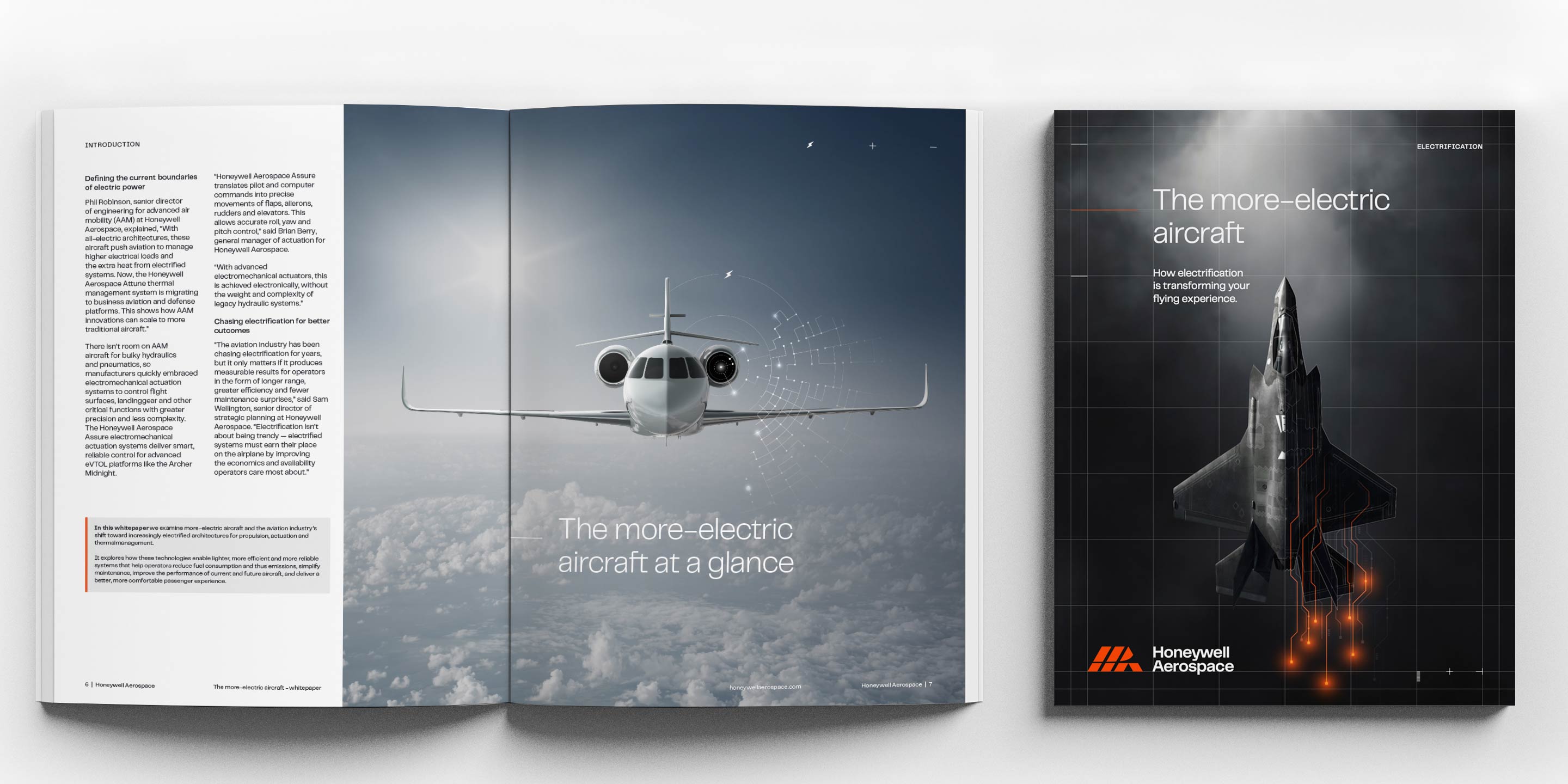
Go beyond motion controls
Motion controls are one part of a broader shift toward more-electric aircraft. Read our whitepaper to explore the technologies, engineering decisions and system integration shaping the next generation of flight.