Your browser is not supported.
For the best experience, please access this site using the latest version of the following browsers:



By closing this window you acknowledge that your experience on this website may be degraded.
How electrification is changing aircraft propulsion
Electrification is influencing how propulsion systems are designed, integrated and powered across the next generation of aircraft.
Key Takeaways
- Why electrification is influencing aircraft propulsion across commercial, defense and advanced air mobility platforms
- Why hybrid-electric propulsion is gaining momentum across a range of aircraft missions
- How propulsion is becoming more closely connected with the aircraft's electrical systems
Why propulsion is changing
Aircraft are demanding more onboard power than ever before. Commercial aircraft continue adding connected systems. Defense platforms require increasing electrical capacity for sensors, mission equipment and electronic warfare. Advanced air mobility (AAM) aircraft are also introducing entirely new propulsion architectures. Those changes are reshaping how propulsion is designed and integrated.
Electrification doesn't mean every aircraft is moving toward battery-powered flight. Instead, it reflects a broader shift in aircraft design where propulsion, onboard power generation and thermal management are becoming more closely connected.
What’s driving more-electric propulsion
More-electric aircraft aren't new. In fact, Boeing's 787, which entered commercial service in 2011, demonstrated what a more-electric architecture could look like by replacing many traditional pneumatic systems with electrically powered alternatives. The result was improved efficiency and reduced reliance on engine bleed air, which is an approach that continues to influence development today.
AAM is accelerating the propulsion evolution, too. Aircraft like Archer's Midnight rely on distributed electric propulsion, requiring propulsion, thermal management, power generation and flight controls to be designed together from the beginning rather than developed separately.
Although commercial airliners, business aircraft and military platforms have very different mission requirements, they face the same engineering challenge of supporting greater electrical demand without adding weight, complexity or fuel burn.
Different aircraft, different solutions
Aircraft electrification is expanding the range of propulsion solutions available to aircraft manufacturers. Battery-electric aircraft continue advancing shorter-range missions, while hybrid-electric propulsion is gaining attention for applications that need greater range, payload or operational flexibility than current battery technology can provide.
Hybrid-electric architectures combine conventional propulsion with onboard power generation, allowing energy to be generated, stored and distributed according to the aircraft's mission.
"Electrification is seen, number, one as a way of increasing efficiency."
Phil Robinson
Senior Director of Engineering, Advanced Air Mobility, Honeywell Aerospace
Hydrogen is another area of active development. Honeywell Aerospace is leading Project NEWBORN under the European Union's Clean Aviation program to develop a megawatt-class hydrogen fuel cell propulsion technology for future regional aircraft.
Different aircraft solve different operational problems. That's why commercial aviation, defense and AAM are advancing a variety of propulsion architectures instead of converging on a single solution.
How propulsion depends on onboard power generation
Propulsion still produces thrust, but in more-electric aircraft it also depends on how efficiently onboard power is generated, distributed and managed. As propulsion becomes more connected with onboard power generation, energy storage and thermal management, those systems are being designed together rather than independently. Higher electrical loads increase demands on each system without adding unnecessary weight or complexity. Hybrid-electric aircraft make that relationship especially clear.
"Electrification is seen, number one, as a way of increasing efficiency," explains Phil Robinson, senior director of engineering for advanced air mobility at Honeywell Aerospace.
The same principles are influencing propulsion across commercial, defense and AAM platforms.
Looking ahead
The future with more-electric propulsion will take many shapes. Battery-electric aircraft, hybrid-electric architectures, hydrogen fuel cells and conventional gas turbines will each serve different missions as technologies mature.
Explore how Honeywell Aerospace is advancing more-electric aircraft through propulsion, motion controls, air and thermal management, and flight systems.
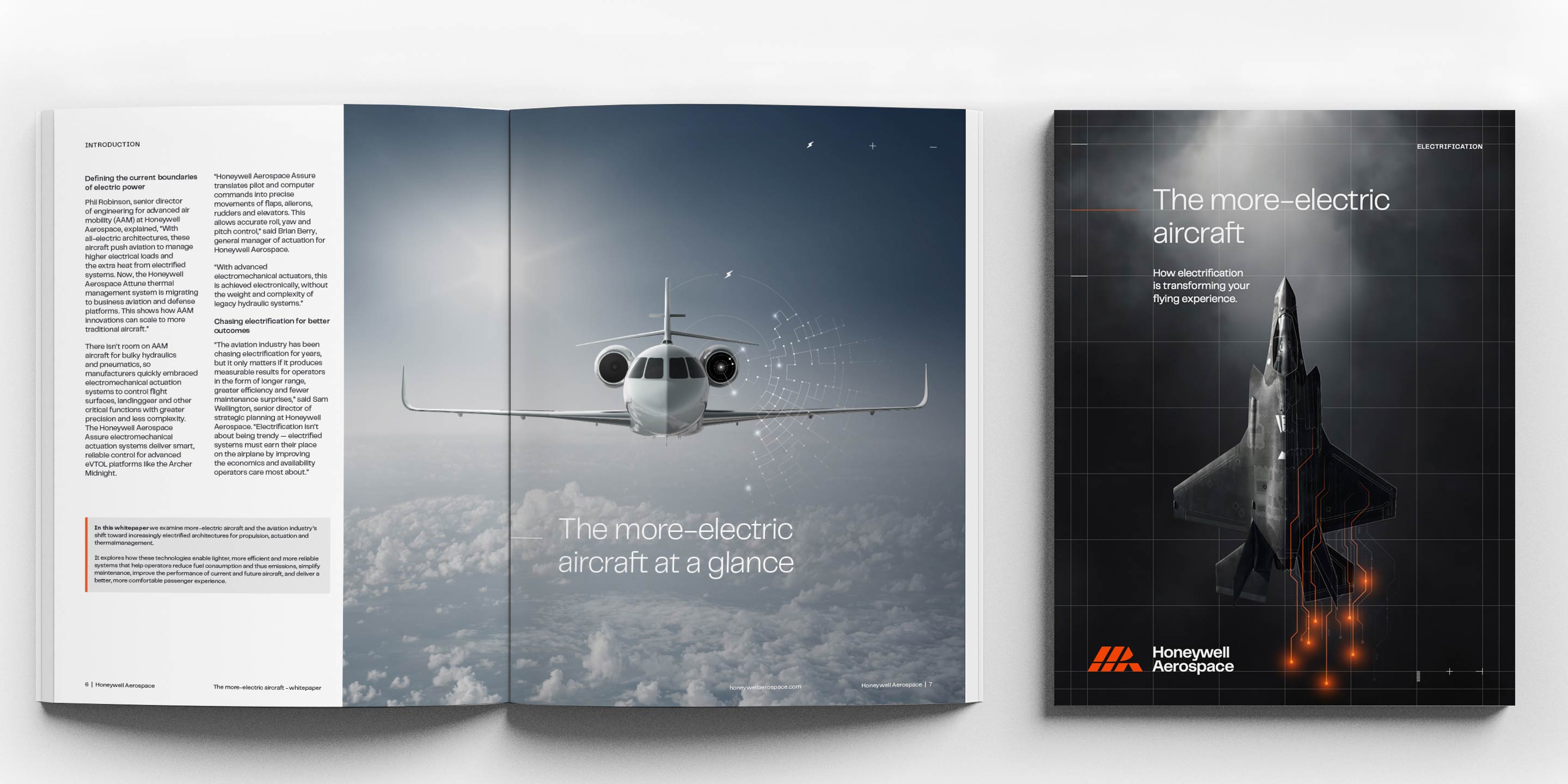
Honeywell Aerospace's approach to more-electric propulsion
From hybrid-electric propulsion and onboard power generation to hydrogen fuel cells and thermal management, learn how Honeywell Aerospace helps manufacturers develop the technologies shaping the next generation of aircraft.