


QAT and Mini Q Energy Accelerometers
Overview
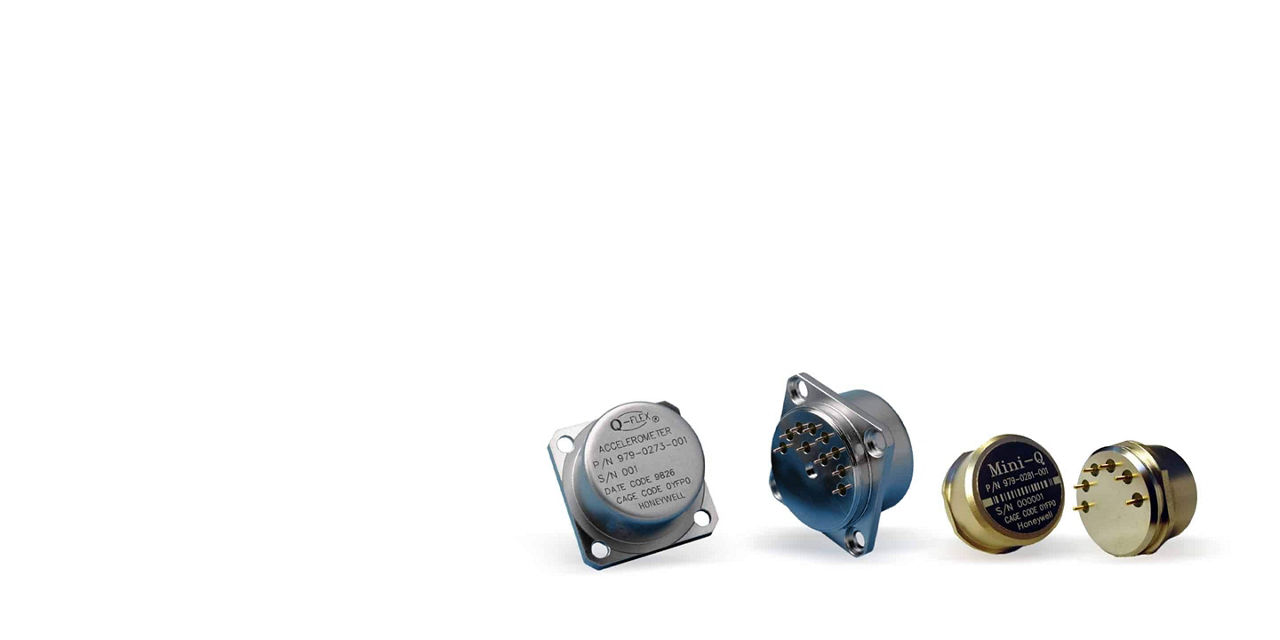
Honeywell produces the QAT (160C and 185C versions) and the Mini Q (150C, 185C and 200C) high-temperature Energy Accelerometers for down hole measurement-while-drilling and wireline applications. High temperature accelerometers are designed to survive in extreme heat or cold environments and require precise acceleration information like drilling. These accelerometers and pressure sensors provide critical data that prevents failures and reduces downtime.
Honeywell’s Q-Flex design is ruggedized for high temperature and specifically customized for the demands of oil and gas applications. QAT and Mini Q products feature a patented Q-Flex etched-quartz-flexure seismic system and its amorphous quartz proof-mass structure provides excellent bias, scale factor and axis alignment stability.
The integral Q-Flex electronics develop an acceleration-proportional output current providing both static and dynamic acceleration measurements. By use of a customer-supplied output load resistor, appropriately scaled for the acceleration range of the application, the output current can be converted into a voltage.
Honeywell’s Q-Flex design is ruggedized for high temperature and specifically customized for the demands of oil and gas applications. QAT and Mini Q products feature a patented Q-Flex etched-quartz-flexure seismic system and its amorphous quartz proof-mass structure provides excellent bias, scale factor and axis alignment stability.
The integral Q-Flex electronics develop an acceleration-proportional output current providing both static and dynamic acceleration measurements. By use of a customer-supplied output load resistor, appropriately scaled for the acceleration range of the application, the output current can be converted into a voltage.
Specifications
Bias
- <15 mg (Mini Q)
- <20 mg (QAT)
Bias - Residual Modeling Error
- <450 μg (QAT)
- <600 μg (Mini Q)
Vibration Rectification
- < ± 100 µg/ g^2 (QAT)
Resolution/Threshold
- <1 µg (Mini Q)
- <5 µg (QAT)
Vibration Peak Sine
- 30g peak, 50 to 800Hz (QAT)
Scale Factor
- 1.3 mA/g (Mini Q)
- 2.75 mA/g ± 1.8% (QAT)
Key Benefits
- Low-power electronics
- Temperature-compensating algorithms dramatically improve bias, scale factor, and axis misalignment performance
Bandwidth
- <200 Hz (QAT)
Models
- MiniQ 150
- MiniQ 185
- QAT 160
- QAT 185
Shock
- 1000 g (Mini Q) (Operating)
- 1000 g (QAT) (Operating)
- 2000 g (Mini Q) [Survival (-40 to 70°)]
- 2000 g (QAT) [Survival (-40 to 70°)]
Axis Misalignment - One-year Composite Repeatability
- <400 µrad (QAT)
Axis Misalignment
- <3 mrad (QAT)
- <6.5 mrad (Mini Q)
RSS Bias and Scale Factor - One-Year Repeatability
- 1.5mg (QAT 185)
- 1.8mg (MiniQ 150)
- 1.8mg (MiniQ 185)
- 1.8mg (MiniQ 200)
- 1mg (QAT 160)
Scale Factor - Residual Modeling Error
- <400 ppm (Mini Q)
- <450 ppm (QAT)
Vibration (Random)
- 20 grms (QAT)
- 30 grms (Mini Q)
Output
- Analog
Quiescent Current per Supply
- 6 mA (QAT)
Quiescent Power
- 180m Watts (QAT)
Input Voltage
- ± 12 to ± 18 VDC (Mini Q) voltage alternating current
- ± 12.5 to ± 15.5 VDC (QAT) voltage alternating current
Input Range
- ±20 g (Mini Q)
- ±20 g (QAT)
Survival Temperatures
- -40°C to 175°C (QAT 160)
- -40°C to 200°C (QAT 185)
- -40°C to 215°C (MiniQ 150)
- -40°C to 215°C (MiniQ 185)
- -40°C to 215°C (MiniQ 200)
Operating Temperature
- 0 to 150°C (MiniQ 150)
- 0 to 160°C (QAT 160)
- 0 to 185°C (MiniQ 185)
- 0 to 200°C (MiniQ 200)
- 0°C to 185°C (QAT 185)
Weight
- 25 grams (Mini Q)
- 55 grams (QAT)
Size
- 0.79in Diameter (2 cm) x 0.57in High (1.4 cm) millimetre
- 1.0in Diameter (2.5 cm) x 0.73in High (1.9 cm) millimetre
Product Number
Parts
_self
Filters